Bright future for electricity from plastic: EU research project "LARGECELLS" for large-scale application of organic photovoltaics
12/10/2010
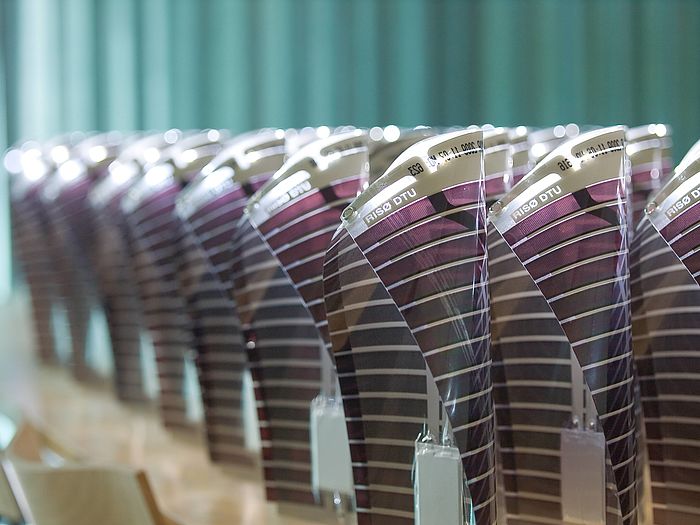
Bayreuth/Munich – The vision of Prof. Mukundan Thelakkat, Professor for Applied Functional Polymers at the University of Bayreuth, is revolutionary: in 10 to 20 years, flexible plastic solar cells made out of semiconductor polymers, which are able to convert solar energy into electric power, shall be available for a reasonable price. Through an improved efficiency, this next-generation photovoltaic technology should provide an affordable and large-scale supply of solar energy on the basis of printable polymer solar cells. The European Commission has decided to support this vision and to finance, starting early September 2010, the respective international research project with 1.64 M Euros of funding over the next three years. The scientists will meet in Munich on 14th October 2010 for the project kick-off meeting. Under the supervision of Prof. Thelakkat, four academic partners and two SMEs (small-to-medium-sized enterprises) from Denmark, the Netherlands, Germany and Israel, as well as a consortium of scientists from India, are to collaborate on the "LARGECELLS" project (Large-Area Organic and Hybrid Solar Cells).
Fossil fuels are becoming increasingly scarce. In order to reduce the levels of climate-impacting carbondioxide, renewable sources of energy are widely required. Photovoltaics play a particularly crucial role here regarding production of electric power. The problems however are that production of rigid, inorganic photovoltaic elements from pure silicium requires high amounts of energy and are also expensive. Organic photovoltaics (OPV) based on polymers represent an alternative. These “plastic solar cells” can be produced energy-efficiently and at a reasonable price, while offering the additional advantage of being flexible in their applicability. However, the attribute of large-scale application hasn’t yet been successful due to its comparably low power conversion efficiency. Yet to be researched as well are the long-term stability and the mechanisms of degradation in polymer-based solar cells, which have up to now hampered their practical application or commercialization.
"Energy demand today is enormous worldwide, particularly in the emerging markets, which are quickly developing into huge industrial nations", says Prof. Thelakkat. "This demands cost-efficient, environmentally-friendly solutions that can be deployed flexibly all over the world; these solutions would be considerably valuable for those locations lacking the necessary infrastructure for energy supply. Organic photovoltaics are quite capable of fulfilling these requirements. The prerequisite is a considerable improvement in their efficiency, long-term stability and decrease in prices, attributes that we hope to achieve in our research."
New functional materials for a new energy era
The "LARGECELLS" project, started early September 2010, aims at synthesising new and suitable polymeric functional materials for organic photovoltaic cells, in order to achieve a 100% increase in the efficiency level compared to current cells. For this purpose, potential will be researched in reference to both purely organic systems as well as hybrid materials for organic and inorganic semi-conductors. The specific goals involve development of materials with low band gap energy and donor-acceptor systems. To this end, the morphology of the polymeric layers for the photovoltaic cells will be respectively adjusted.
The most promising materials will be refined for their large-scale application in novel and state-of-the-art manufacturing processes on the basis of roll-to-roll processes. The Danish firm Mekoprint has assumed the responsibility for technological realisation of the project.
Long-term stability tests
Stability and degradation mechanisms within the new solar cells will be examined in the Negev Desert (Israel) and in India by means of indoor and outdoor experiments using accelerated ageing processes. The results of these experiments, which will take place under realistic operational conditions, will be taken into consideration for further development of optimal carrier materials.
Close collaboration with Indian scientists
In the context of calls for tenders within the 7th Framework Programme (FP7) of the EU, collaboration with certain countries outside the EU is supported. In this case, five top-class scientific institutions from India are taking part in the LARGECELLS project. The Indian researchers will collaborate very closely with their EU colleagues in the area of development of new materials and outdoor tests. Moreover, an intensive exchange of knowledge and personnel has been planned; scientists and students on both sides will visit their colleagues from the other consortium on a regular basis, thus assuring an optimal exchange of knowledge and significant synergies in research work. The Indian consortium is being separately financed by the Department of Science and Technology, Indian Ministry of Science.
Contact persons
Project coordinator
Prof. Dr. Mukundan Thelakkat
Applied Functional Polymers
University of Bayreuth
Tel. +49-921-55 3108
Mail: mukundan.thelakkat@no-spam-pleaseuni-bayreuth.de
Project manager
Dr. Panteleimon Panagiotou
Scientific Officer
Bavarian research Alliance
Tel. +49-9901-888-130
Mail: panagiotou@no-spam-pleasebayfor.org

Competence Centre for Research and Innovation Funding in Bavaria, Europe and the World
Competence Centre for Research and Innovation Funding in Bavaria, Europe and the World