Background of the Scientific Coordination Office Bavaria-Québec/Alberta/International
The Free State of Bavaria and the Province of Québec in Canada have a more than 35-year history of extensive intergovernmental cooperation. In this frame, the Scientific Cooperation Office (WKS) Bavaria-Québec/Alberta/International fosters continuously the development of joint research projects in engineering and natural sciences. In addition, the office supports individual cooperation initiatives with the Western Canadian Province of Alberta. At the federal level, the WKS Bavaria-Québec/Alberta/International has a partnership agreement with the National Research Council NRC. Since Canada’s association with the European Research Framework Programme, it has supported joint projects under Pillar II of Horizon Europe.
On behalf of the Bavarian State Chancellery, the Scientific Cooperation Office operates as the Lead Management Partner in the multilateral science network of the seven Regional Leaders Summit (RLS) regions, known as RLS-Sciences.
Since 2020, the WKS Bavaria-Quebec/Alberta/International has also been supporting special initiatives of the Bavarian State Chancellery, among them the Bavaria-Poland MedTech project office.
Support services:
The WKS Bavaria-Québec/Alberta/International supports scientists at Bavarian universities and universities of applied sciences who wish to carry out research and innovation projects in the above-mentioned countries and regions. The following tasks are performed on a country-specific basis:
- Support for international cooperation projects in research and innovation
- Scientific, administrative, and financial support (mobility grants) for bilateral projects, from conception to implementation
- Networking activities between various research and innovation stakeholders, for example by accompanying delegation trips
- Project-related establishment of multilateral R&I consortia
Bavaria-Québec
Background of the scientific cooperation Bavaria-Québec
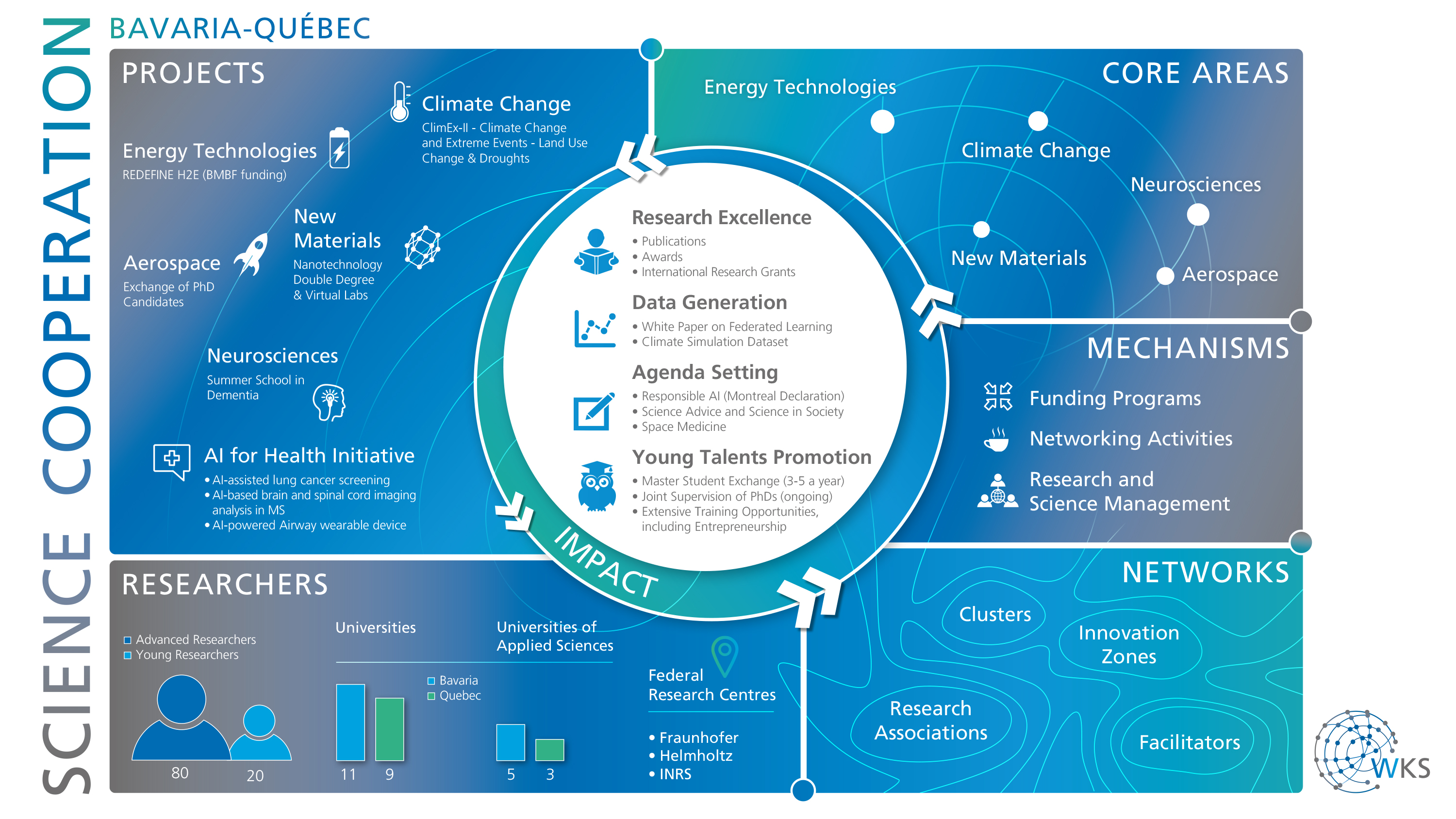
Current cooperation between Bavaria and Québec is based on a longstanding tradition of partnership which began in the early 1980s and was institutionalized in 1989. This cooperation spans into broad areas such as politics and administration, economy, science, research and technology, social and academic education, culture and society. Important synergy effects are also achieved in the interplay.
In joint workgroup conferences, which take place every two years in Bavaria and Québec, content-based priorities are established for the following two-year term. The 18th workgroup conference took place in Munich in 2025. Additionally, half-time meetings make regular coordination and monitoring of the projects possible. Both sides have federal subsidies at their disposal for the financial support of joint initiatives according to the principle of reciprocity.
In the field of science, research and technology, the mobility program is particularly emphasized. This enables activities for the networking of scientists from Bavaria and Québec and in the process guarantees initial funding for existing research plans.
The position, embedded in the Bavarian Research Alliance GmbH, of a senior scientific consultant for international research association in Bavaria (with Québec/ Canada in particular), accompanies these projects as an assignment from the Bavarian State Chancellery and in cooperation with the representatives from the Free State of Bavaria in Québec.
Bavaria-Alberta
Background of the scientific cooperation Bavaria-Alberta
In contrast to the multi-year cooperation between Bavaria and Québec, which progresses within a fixed framework of institutional cooperation, the scientific-technological dialogue with Alberta is only in its initial phase. Nevertheless, in strategic sectors such as energy, information and communication technologies (ICT), and life sciences, both joint research interests as well as complementary approaches are already available in many different ways.
This dialogue started in the context of the delegation-trip, initiated by Vice Minister Hans Spitzner, to Alberta in 2007. In addition to representatives from politics and economics, seven scientists from Bavarian universities and research centers took part in the trip. In discussions with scientists from Alberta, it was possible to line up bi-lateral research cooperation projects, which still exist. Regular student and faculty exchanges between universities in Bavaria and Alberta were increased.
During the delegation trip led by Vice Minister Katja Hessel in 2011, a first cross-disciplinary scientific network called ABBY-Net arose that is evaluating the co-evolution of energy systems and ecosystems. Together, the members of this network want to take part in international cooperative research efforts with partners from industry.
The 5th of June 2013 Minister Dr. Wolfgang Heubisch and the Honourable Thomas Lukaszuk, Deputy Premier of Alberta, Minister of Enterprise and Advanced Education signed a Letter of Intent in Research and Technology.
On the 23rd October 2017, the Bavarian government and the government of the Province of Alberta signed a joint extended declaration to strengthen their cooperation in research and innovation.
On behalf of the Bavarian State Chancellery, the Scientific Coordination Office of the Bavarian Research Alliance supports the development of mutual research projects.
More information about the scientific cooperation Bavaria-Alberta.
RLS Partner Regions
About RLS
The Regional Leaders Summit (RLS) is a forum comprising seven regional governments (state, federal state, or provincial), which together represent approximately 177 million people across five continents, and a collective GDP of 3 trillion USD.
The seven regions are:
- Bavaria (Germany)
- Georgia (USA)
- Québec (Canada)
- São Paulo (Brazil)
- Shandong (China)
- Upper Austria (Austria)
- Western Cape (South Africa)
There are areas where the seven members share existing competencies and excellence in science and innovation. In order to leverage the RLS network, RLS-Sciences designated five thematic areas where there is the most potential for cooperation:
- Digitalization
- Aerospace
- Small Satellites
- Renewable Energy
- Digital Health

Since 2002, the heads of government for these regions have met every two years for a political summit. These summits offer the RLS regions an opportunity for political dialogue. During the sixth summit in São Paulo in 2012, the RLS member states adopted a Final Declaration, which included a commitment to joint research and innovation initiatives in the field of renewable energy.
''In order to increase the proportion of renewable energy in the total energy consumption, as well as contribute to the security of energy supply and to promote renewable energy on a global scale, we invite our universities, research institutes, and industrial clusters to join forces in the formation of a network, centered on renewable energy and energy efficiency, so that innovations and new products will be developed to achieve these goals. This initiative will be led by the Government of the State of São Paulo until 2014. The intensification of the cooperation in research is necessary to implement these technologies in renewable energy sources and energy efficiency broadly and at a reduced cost.''
Within the framework of RLS, RLS-Sciences seeks to leverage the unique composition and strengths of the RLS network to support scientific research within and between the RLS regions. It works to generate and support academic, scientific, and technological exchanges, as well as the initiation of multilateral research projects.
Review the structure of RLS-Sciences here.
Past Summits
- 3-5 November 2025 - Western Cape, South Africa
- 25-26 September 2023 - Shandong, China
- 11 November 2021 - Linz, Austria
- 17-18 May 2018 - Québec, Canada
- 14-15 July 2016 - Munich, Germany
- 2-3 June 2014 - Atlanta, USA
- 11-12 April 2012 - São Paolo, Brazil
- 27-29 September 2010 - Cape Town, South Africa
- 6-7 August 2008 - Georgia, USA
- 11-12 July 2006 - Linz, Austria
- 9-10 December 2004 - Québec, Canada
- 30-31 January 2002 - Munich, Germany
Cooperation Office MedTech Bavaria-Poland
The Cooperation Office MedTech Bavaria-Poland aims at supporting bilateral cooperation projects in medical technologies. The Cooperation Office was launched in 2023 by the Bavarian State Chancellery with AHK Polska and WKS Bavaria-Québec/Alberta/International as implementation partners. Within this context, WKS Bavaria-Québec/Alberta/International encourages the development and implementation of scientific projects in the field of medical technologies with researchers from Bavaria and Poland. In pursuit of this objective, networking opportunities are offered, and assistance is provided to align project ideas with suitable funding opportunities. Depending on the needs of the consortium, the application process can also be supported.
More information can be found here.