Research and development expenditure of EU member states is set to rise to over €403 billion by 2024
05/12/2025
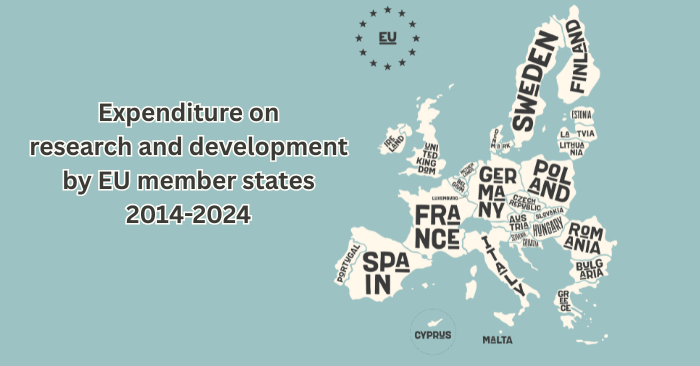
Stable R&D intensity at 2.2%
R&D intensity is defined as R&D expenditure as a percentage of GDP. Since 2014, this figure has increased by 0.1 percentage points.
Overall, 19 EU member states recorded an increase in their R&D intensity between 2014 and 2024, with the most significant increases in:
- Belgium: +1.0 percentage points
- Greece: +0.7 percentage points
- Estonia & Croatia: +0.6 percentage points each
Leading and catching-up countries
The European Council's target of achieving an R&D intensity of at least 3% by 2024 was met by six EU countries:
- Sweden: 3.6%
- Belgium: 3.4%
- Austria: 3.3%
- Finland: 3.2%
- Germany: 3.1%
- Denmark: 3.0%
Romania and Malta were at the lower end of the scale with 0.5%, while Cyprus, Bulgaria, Latvia, Slovakia and Luxembourg were slightly higher with 0.7–1.0%.
Business sector remains the biggest driver of R&D
In 2024, the business sector continued to account for the majority of R&D expenditure, with 66.5% of total investment (€268.1 billion) coming from this sector. This was followed by:
- Universities: €86.1 billion (21.4%)
- Public sector: €43.5 billion (10.8%)
- Private non-profit sector: €5.4 billion (1.3%)
Classification of data
R&D intensity provides an indication of the strategic importance of research and development in individual EU countries.
However, it should be noted that these statistics cover all public and private R&D expenditure in the member states. Consequently, they are only indirectly related to EU funding programmes, such as Horizon Europe, and do not permit conclusions to be drawn about the success of individual countries in attracting such funding.

Competence Centre for Research and Innovation Funding in Bavaria, Europe and the World
Competence Centre for Research and Innovation Funding in Bavaria, Europe and the World