ProtectEU: European Commission unveils new agenda to combat terrorism
13/03/2026
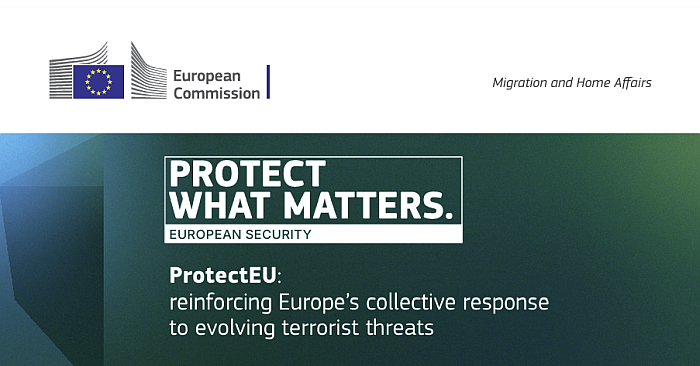
With this agenda, the EU is responding to an increasingly complex security situation. Terrorist networks now operate more digitally, utilise new technologies and frequently act in small, flexible cells or as lone actors. At the same time, the role of online radicalisation, disinformation and geopolitical conflicts – which can reinforce extremist narratives – is growing.
New threats: technology, online radicalisation and geopolitical conflicts
The Commission sees the misuse of digital technologies in particular as a key challenge for security authorities. Terrorist actors are increasingly using:
- social media and encrypted communication platforms
- generative artificial intelligence to create extremist content
- cryptocurrencies and digital payment systems to finance
- drones or 3D-printed weapons to prepare attacks
At the same time, an increasing radicalisation of minors is being observed online. Extremist groups specifically target young people via gaming platforms, social networks or online communities.
Six key areas of action in the ProtectEU Agenda
The new EU Agenda comprises a series of cross-sectoral measures to improve prevention, protection and response capabilities within the European Union.
1. Detecting threats at an early stage
The EU aims to strengthen its analysis and early warning systems. This includes:
- Expanding the EU’s intelligence analysis capacity (SIAC)
- enhanced analytical and open-source intelligence capabilities at Europol
- more security research into technologies such as AI, crypto-assets, drones and 3D-printed weapons under Horizon Europe and the EU Internal Security Fund.
2. Preventing radicalisation
Prevention remains the most effective long-term strategy. Plans include, amongst other things:
- an EU prevention toolbox to combat the radicalisation of minors
- a €5 million programme to strengthen communities and youth projects
- enhanced education and integration measures to promote societal resilience
3. Protection against online radicalisation
The EU intends to take stronger action against extremist content on the internet. Plans include:
- consistent implementation of the Digital Services Act (DSA)
- possible revision of the Regulation on terrorist content online
- expanding cooperation with platforms via the EU Internet Forum
4. Protection of public spaces and critical infrastructure
To better secure physical targets, the Commission plans:
- €30 million for projects to protect public spaces
- enhanced security advice for Member States
- measures against new methods of attack such as drones and 3D-printed weapons
5. Rapid response to threats and attacks
Operational cooperation between law enforcement agencies is to be improved, for example through:
- stronger mandates for Europol and Eurojust
- new tools to combat terrorist financing
- better access to digital evidence for investigative authorities
6. More intensive international cooperation
As terrorism is increasingly organised on a global scale, the EU wants to expand cooperation with partners outside Europe. This includes:
- closer cooperation with Western Balkan countries and Mediterranean partners
- stronger international police cooperation
- expansion of multilateral initiatives to combat terrorism.
EU focuses on prevention, technology and international cooperation
With the ProtectEU Agenda, the European Union is pursuing a comprehensive approach: identifying threats early, preventing radicalisation, protecting people and responding decisively when attacks are threatened or occur. The aim is to strengthen the security of citizens, businesses and public institutions in Europe in the long term.

Dr. Alexander Christian Widmann
Team Coordinator and Scientific Officer Social Sciences and Humanities | Security and Defence Research
Phone: +49 89 9901888-162
Email: widmann@no-spam-pleasebayfor.org

Competence Centre for Research and Innovation Funding in Bavaria, Europe and the World
Competence Centre for Research and Innovation Funding in Bavaria, Europe and the World