EU project TwinVECTOR strengthens Czech excellence in battery research through European collaboration
01/12/2025



01.12.2025
Image material for the press release on the end of the EU project TwinVECTOR
EU Project TwinVECTOR – Pooling European competence in the development of world-class next-generation batteries

 Download
© ZETHA_WORK/AdobeStock
01.12.2025
Image material for the press release on the end of the EU project TwinVECTOR
TwinVECTOR Logo
 Download
© TwinVECTOR
01.12.2025
Image material for the press release on the end of the EU project TwinVECTOR
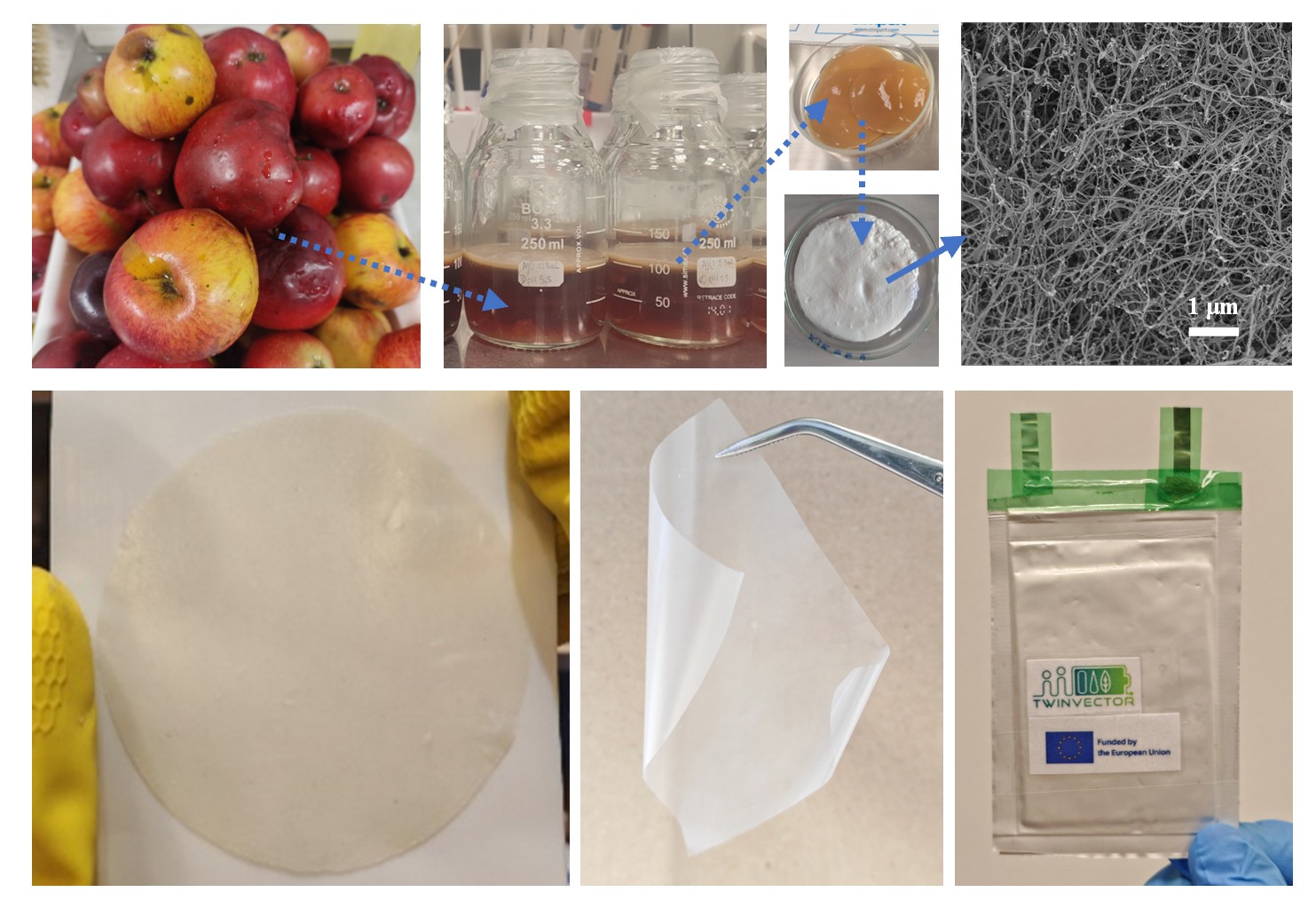
Bacterial cellulose from fallen apples for polymer electrolyte and separator in lithium-metal batteries.

 Download
© Tomas Bata University
The EU project TwinVECTOR focused on positioning TBU as a competitive player within the European Research Area by creating a shared pool of knowledge for sustainable battery development across the entire life cycle. During the project lifetime, multidisciplinary research was conducted on lithium-ion batteries, focusing on improved sustainability, with a special emphasis on the safety and reliability as well as the use of renewable and bio-based materials. The project combined expertise in chemistry, engineering, and sustainability to tackle challenges across the entire battery life cycle.
Innovation for safer batteries and sustainable design
In the frame of TwinVECTOR, TBU researchers have developed a new modified solid polymer electrolyte reinforced with bacterial cellulose – a natural material that enhances battery stability, safety and sustainability. Unlike conventional electrolytes, which are often flammable liquids, this solid polymer version is mechanically strong and non-flammable. The addition of bacterial cellulose creates a fine nanofiber network that enables faster and more efficient lithium-ion transport, improving both battery performance and durability.
Bacterial cellulose can be produced sustainably from plant-based sources such as apple juice, and it shows strong potential for renewable energy storage applications.
Laboratory tests demonstrated improved reliability up to 4.1 V, indicating that the material stays stable within the voltage range used in most modern lithium-ion batteries. In parallel, the project evaluated the environmental impacts of the new electrolyte through Life Cycle Assessment (LCA), considering among others greenhouse gas emissions and energy consumption. Beyond that, techno-economic parameters including future scalability were assessed.
Building knowledge through European collaboration
TwinVECTOR was funded as part of the "Twinning" funding scheme of the EU, which strengthens institutional cooperation and the exchange of best practices among European research institutions. The project fostered exchanges between partner institutions, helping to sharpen the research profiles of individual scientists at TBU and expand the expertise of administrative staff. Within this framework, TwinVECTOR not only advanced research but also became a central hub for networking, capacity building, and matchmaking in Europe. The project partner institutions contributed in multiple ways:
- BayFOR organised high-impact training (e.g. project management, proposal writing, intercultural communication, public relations) and matchmaking events, such as the Enterprise Europe Network Battery & Hydrogen Brokerage Event, and a Bavarian roadshow connecting TBU with the Bavarian battery ecosystem and leading battery R&D centres to foster upcoming collaborations.
- VTT strengthened hands-on cooperation through laboratory exchanges and one-on-one mentoring, including pouch cell assembly training and joint electrochemical testing.
- KIT deepened collaboration via regular research sessions, LCA workshops, and introduced the “Sustainability Theatre” – an interactive format that brings together scientists, engineers, and social researchers to collaboratively discuss life cycle-based sustainability practices in battery research.
- AIT led techno-economic modelling workshops and researcher exchanges, developing a shared training roadmap to strengthen long-term skills development at TBU, and hosted a Summer School on techno-economics and business modelling of energy storage technologies.
These activities significantly enhanced TBU’s visibility and engagement within major European initiatives such as the Batteries European Partnership Association (BEPA), the European Energy Research Alliance (EERA), and the Clean Energy Transition Partnership.
Through the various workshops, training sessions and joint publications, the project has created new opportunities for early-career researchers and administrative staff alike. Beyond its three-year duration, the project aims to establish further durable partnerships and pave the way for new EU research initiatives.
Empowering Czech Battery Research for Europe’s Clean Energy Transition
As one of the EU’s “widening countries”, the Czech Republic holds strong potential for developing its own innovation ecosystem. Through TwinVECTOR, TBU has improved its ability to participate in international research consortia and increased its visibility within the European Research Area, laying the groundwork for future international collaborations. TwinVECTOR has demonstrated how strategic partnerships and knowledge exchange can accelerate sustainable battery innovation and strengthen Europe’s overall competitiveness in battery research.
“TwinVECTOR is a story of focus, dedication and endurance — not only in battery research, but also in sustainability and techno-economics. It brought together passionate researchers who share a commitment to advancing Europe’s clean energy transition”, says Dr Viera Pechancová, project coordinator at Tomas Bata University in Zlín.
About the EU project TwinVECTOR
TwinVECTOR (www.twinvector.eu) started on 1 November 2022 and ran until the end of October 2025. TwinVECTOR aimed to expand the research and management capacities of the Centre of Excellence at Tomas Bata University (TBU) in Zlín, Czech Republic through institutional cooperation, thereby strengthening Czech excellence in battery research through European collaboration. The project was carried out by the TBU, together with four other partners from Germany, Austria, and Finland. The project was managed by Dr Viera Pechancová, project manager and researcher at TBU. The EU supported the project with EUR 1.3 million under the European framework programme for research and innovation "Horizon Europe".
TwinVECTOR profile:
Project name: TwinVECTOR (Grant Agreement Nr. 101078935) – Twinning for development of world-class next-generation batteries
Duration: 11/2022 – 10/2025
Internet: www.twinvector.eu
Coordination: Dr Viera Pechancová, Tomas Bata University in Zlin, Czech Republic
Project partners:
- AIT Austrian Institute of Technology GmbH, Austria
- Bavarian Research Alliance GmbH, Germany
- Karlsruhe Institute of Technology, Germany
- VTT Technical Research Centre of Finland Ltd, Finland
Programme: Horizon Europe
Total funding amount: EUR 1.3 million
Funding: European Union
Press Contact
Tomas Bata University in Zlín
Dr. Viera Pechancova
Project manager & researcher
Mobile: +420 603 860 819
Email: pechancova@utb.cz

Funded by the European Union. Views and opinions expressed are however those of the author(s) only and do not necessarily reflect those of the European Union. Neither the European Union nor the granting authority can be held responsible for them.

Competence Centre for Research and Innovation Funding in Bavaria, Europe and the World
Competence Centre for Research and Innovation Funding in Bavaria, Europe and the World