EU project BEACON-HD – Innovative approaches to hypertension and type 2 diabetes care for patients in Rwanda and Uganda
Effective drugs for high blood pressure and type 2 diabetes have been available for quite some time. In rural regions of Rwanda and Uganda, however, many patients find it difficult to access continuous treatment. The EU project BEACON-HD aims to close this gap in care with telemedicine and community medication delivery. The aim is to improve care for chronically ill people and strengthen primary health care in the long term.
High blood pressure and diabetes: Effective therapies are available – access is the problem
High blood pressure and type 2 diabetes are among the most common chronic diseases. In the two pilot regions of BEACON-HD alone – Burera in Rwanda and Nakaseke in Uganda – it is estimated that around 85,000 people are affected by high blood pressure and/or diabetes.
The central challenge here is not to develop new drugs: effective treatment options are available, but do not reach many people in the long term. Especially in rural regions, there is a shortage of healthcare professionals and easily accessible health facilities. In the BEACON-HD pilot regions, journeys to a healthcare facility can take more than three hours. As a result, many patients are diagnosed late or unable to regularly attend follow-up appointments, receive treatment, or maintain a continuous supply of medication.
Telemedicine and community medication delivery
BEACON-HD addresses these challenges by evaluating innovative care models for rural regions in Rwanda and Uganda. The project, which is funded by the EU’s Horizon Europe research and innovation programme, brings together twelve partners from Europe, Africa and North America.
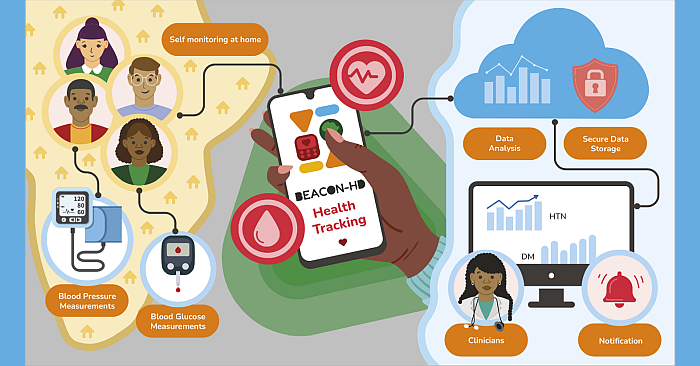
A central component is the telemedicine platform CarePulse, which is being developed in the project. Patients regularly measure their blood pressure and/or blood sugar themselves and transmit the values to the CarePulse system via mobile phone. Healthcare professionals can assess the values remotely, detect changes at an early stage and adjust further treatment as needed. CarePulse is designed in such a way that central functions can also be used with simple mobile phones via SMS and not exclusively with smartphones.
The second approach is community medication delivery. Trained community health workers collect prescribed medication from health facilities and bring it directly to the communities. This means that patients do not have to travel long distances to collect medication on a regular basis.
Both approaches are being adapted to local conditions together with patients, medical professionals, community health workers, and representatives from health facilities and health authorities. The aim is to create solutions that can be integrated into existing health systems in the long term.
Practical research: What works in everyday care?
BEACON-HD is investigating how effective the new care models are and how well they can be implemented in practice in 160 villages in Rwanda and Uganda. A total of around 4,500 people with high blood pressure, type 2 diabetes or both diseases are expected to participate in the study and will be followed over twelve months.
The participating villages are randomly assigned to one of four study groups: In addition to a control group with the previous standard care, one group will implement community medication delivery, one telemedicine with self-monitoring, and one group will test both approaches combined. This way, BEACON-HD will be able to compare the contribution made by the individual care models and their combination.
BEACON-HD not only investigates whether blood pressure and blood sugar levels improve. Equally important is the question of how well new approaches can be implemented in everyday care. Among other things, treatment adherence, use and acceptance of the services, as well as their cost-effectiveness and organizational requirements, are analyzed.
The results are intended to show which approaches are suitable for long-term and broader application and under what conditions they can be transferred to other regions with comparable challenges.
Project objectives
BEACON-HD adapts and evaluates new care models for people with hypertension and type 2 diabetes in rural regions of Rwanda and Uganda. The aim is to improve access to continuous and patient-oriented health care and thus strengthen health systems in the long term.
The focus is on two innovative approaches:
- Development and introduction of the telemedicine platform "CarePulse" with self-monitoring for patients,
- Establishment of community medication delivery by local health workers
The solutions developed are adapted to the regional conditions together with local actors, scientifically evaluated and prepared for long-term use and transfer to other regions with comparable challenges.
Target groups
The project results are aimed at stakeholders from health care, policy, science and society, in particular:
- People with high blood pressure and/or type 2 diabetes and their relatives
- Doctors and other health workers
- Community health workers
- Ministries of health, authorities and policymakers
- Researchers
- international health and funding organisations
BayFOR as a partner
The Bavarian Research Alliance (BayFOR) supports the Technical University of Munich (TUM) as project coordinator of BEACON-HD in the administrative and financial project management of the international consortium.
BayFOR's tasks include:
- Support of the project coordinator in daily project management,
- Organization and documentation of consortium meetings,
- Support of partners in administrative and financial matters,
- Support of the reporting process to the European Commission,
- Ensuring efficient collaboration within the consortium.
In addition, BayFOR supports the exploitation and dissemination of the project results.
Funding period
This project will be funded by the European Union from June 2026 to the end of May 2030 as part of the Horizon Europe research and innovation programme with 3.9 million euros under grant agreement no. 101289715. Of this, around 840,000 euros will go to Bavarian stakeholders.
Consortium
The BEACON-HD consortium brings together twelve leading universities, research institutions, non-profit organizations and companies from Europe, Africa and North America. Together, the partners contribute expertise from the fields of medicine, healthcare, health economics, implementation research, social sciences and software development to the project.
Under the coordination of the Technical University of Munich (TUM), the following project partners are working together on the project:
Coordinator: Technical University of Munich (TUM) – Germany
Project partners:
African Community Center for Social Sustainability – (ACCESS) – Uganda
Bavarian Research Alliance (BayFOR) – Germany
bSpoke – Greece
Emory University (EMO) – USA
Erasmus University Rotterdam (EUR) – Netherlands
InoSens – Serbia
Makerere University (MAK) – Uganda
Northwestern University (NU) – USA
Partners In Health (PIH) – USA
University of Birmingham (UoB) – United Kingdom
University of Global Health Equity (UGHE) – Rwanda
Contact

Prof. Dr Nikkil Sudharsanan
TUM School of Medicine and Health
Behavioral Sciences in Prevention and Care
Email: nikkil.sudharsanan@no-spam-pleasetum.de
Contact at BayFOR

Anna Stegmann
Scientific Coordinator Scientific Coordination Office Bavaria-Africa
Phone: +49 89 9901 888-128
Email: stegmann@no-spam-pleasebayfor.org

Competence Centre for Research and Innovation Funding in Bavaria, Europe and the World
Competence Centre for Research and Innovation Funding in Bavaria, Europe and the World